
No, that is not what the doctor said when I was born. It is the premonition I had when I started the business to design, manufacture and sell electronic fuel injection systems for the flathead Ford V8 engine, which was made between 1932 and 1953.
A little background:
When I retired in 1999 from the company I founded, Sandhill Scientific, I thought about what I could do with my life other than sit in a lounge chair, watch TV, and drink beer, which is not a bad idea. I was already into the old car hobby, had joined the Early Ford V8 Club, and purchased a 1940 Ford coupe. It was a throwback to my first car, which was also a 1940 Ford coupe, that I bought in 1954 for $500. I always had a hot rod “bug,” but I never had the time or resources to pursue it. Now with lots of time (and some money), I could contemplate messing with the 1940 Ford and have some fun doing it!
I always really liked the Denver Thanksgiving Car Show as it was a great opportunity to see local club cars and to meet vendors who supplied goods and services to the hobby. One of the exhibitors, Dave Cimbura, was exhibiting an aftermarket fuel injection system that he was developing using his brother John’s design of a F1 throttle body that could be used to replace a conventional carburetor. I knew little about fuel injection, which, at that time, was a still a novel development in the hot rod aftermarket place. While I chatted with Dave, an idea popped into my head: Why not make a system to replace the carburetor on a flathead Ford? Dave was very keen about this idea and told me if I wanted to create this system, he would not only help me learn what to do, but also supply the special components.
I was off and running. The first thing I did was observe how Dave installed a system on his Dodge pickup, which he drove regularly up and down the mountain to his home in Grand Lake.
What I learned:
- The essence of fuel injection is that there are very fast acting solenoid valves that open to squirt gas into the manifold using pulse width modulation.
- The timing and duration of the squirt is done by a computer that has sensors for input and solenoid drivers for output.
- The way that the computer determines when and how long to open the solenoids is determined by the data it get from sensors that measure the operation of the engine.
- The really big trick is the software and its computation algorithms that perform the calculations that determine the parameters for the operation of the solenoid.
Once I observed all the above, it seemed very familiar to me being an instrumentation engineer specializing in medical electronic designs as I implemented the same design approach. I used relays, solenoids, sensors, and microprocessors as tools for physiological measurements and medical treatments. I would be applying basic knowledge and experience I already had to a new field.
Having started my medical electronic business using a $50 desk from Southwestern Bell Telephone surplus sales in a room sublet from the Retarded Citizens Association, I knew that introducing a new product to market is a huge task requiring significant cash to accomplish. To develop this as a new business venture, I would need to research and complete the following tasks:
- Make a business plan
- Secure funding
- Design and test the product
- Meet legal requirements
- Set up manufacturing
- Start a sales effort
- Promote the product – advertising, trade show, key accounts
- Keep payables ahead of receivables
Accomplishing all those tasks was a gut-busting effort, which I endured for 18 years. In the end, I was successful, but I realized that it was an effort I could only do once in my lifetime. I certainly did not want to go down that road again. However, if I limited my goal to the very slim, perhaps nonexistent, market of antique flat head engines and kept costs down to the amount I could afford out-of-pocket, it might be a fun challenge.
Common sense indicated that the market for the product would be SBC (small block Chevy) and 5.0 Fords (think Mustang), not flathead Fords. But I loved the old flathead and that was the engine where I wanted to concentrate the effort. I would let it be known what I was doing and sell the product to those who shared my interest. Thus, Flathead Engineering LLC was born, a business seemingly designed to fail. I would put forth my best effort to make and sell a product that no investor in his right mind would help capitalize. It is just that I would hold the effort and costs down to a level that was sustainable without excess effort or cost.
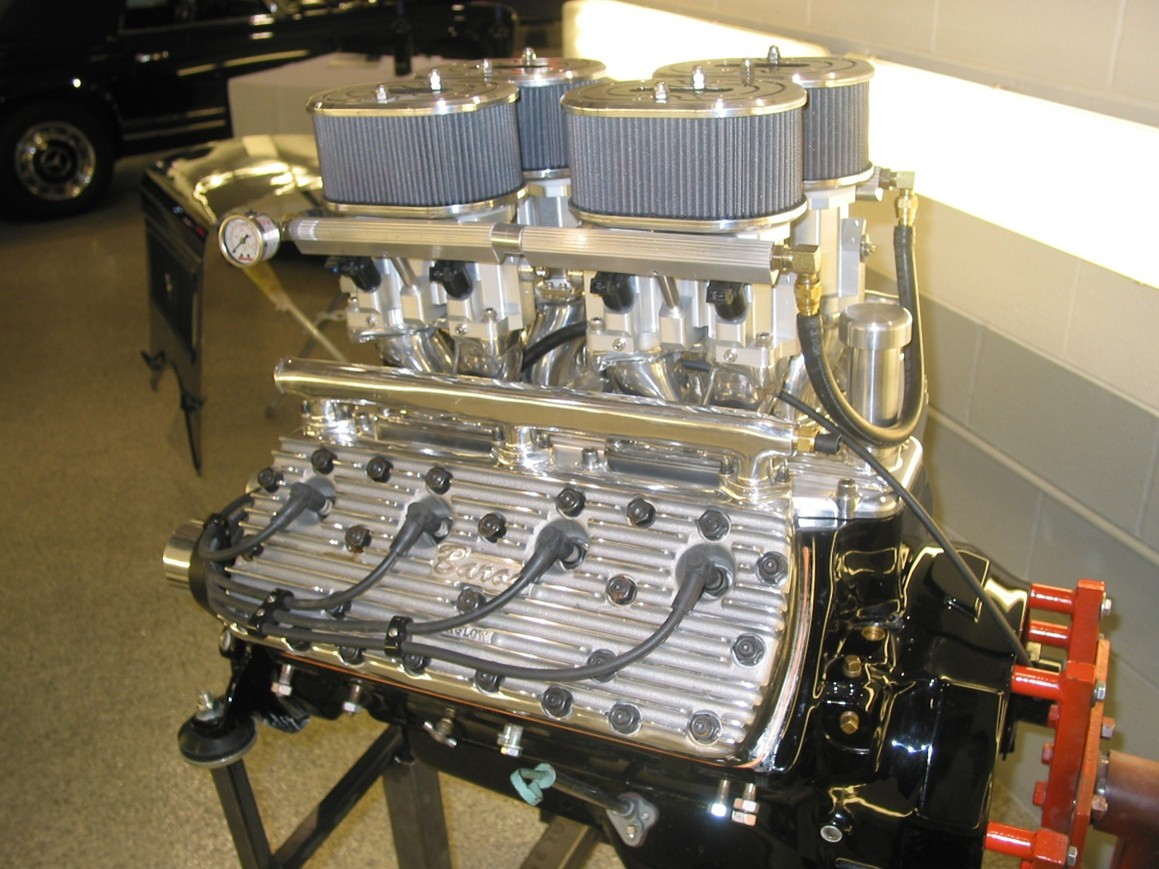 Through Dave Cimbura, I met Tony Baron, the owner of Baron Racing Equipment in Woodland Park, CA, who is the son of Frank Baron, a hot rod pioneer. Tony had designed a manifold and risers that he used on a four Weber carburetor flathead. Our TB was an exact fit for a Weber IDF carburetor, and thus I bought Tony’s manifolds and risers. Lance Nist, owner of Pantera Specialists in Santa Ann, CA, was a dealer for Redline Weber ECU (Electronic Control Unit), which was a very advanced aftermarket product sold to the do-it-yourself market. I was also able to buy sensors and harness supplies from Lance. It was a really good product with minimal instructions, but between Dave and me, we learned how to program it. I had to machine all the risers and fuel manifolds, linkage, as well as plumb all the ports for vacuum lines. This is the resultant product as installed on an engine.
The product was a killer both in appearance and performance, and it was a fantastic attraction at the major trade shows that I did in conjunction with Dave. It was a thrill to meet with Chip Foose and have him give me a personal tour of his Riddler winning car. Another thrill was a chat with Phil Hill, the Formula One world champion, and learning about his travails adjusting Ferrari brakes on the early race cars. Sara and I really enjoyed working these shows.
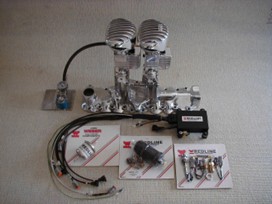 While this was a good product, it was quite expensive with a very limited customer base. Therefore, I had a designer come up with a throttle body design that would work on any flathead engine manifold that was fitted with Ford or Stromberg carburetors, which could be sold at a more reasonable price. This is the product and the accessories:
I knew my customer base might make a total mess of installation of either product, so I ran every system on a test stand with it fully programmed and running with every piece required. Those exact parts were then shipped to the customer. I did not want to be involved in endless phone calls regarding troubleshooting that would certainly be the case if I just packed all the untested components in a box and made the customer assemble the system. It was a bad way to make a profit, but a good way to have a happy customer. I never heard from most customers who purchased the systems as they all had smooth startups.
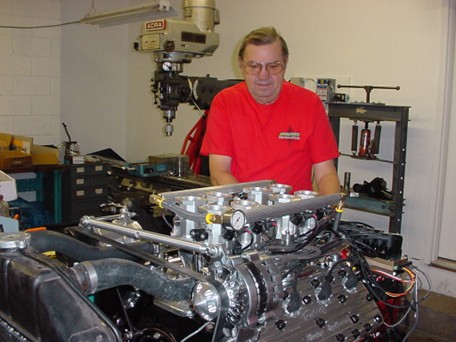
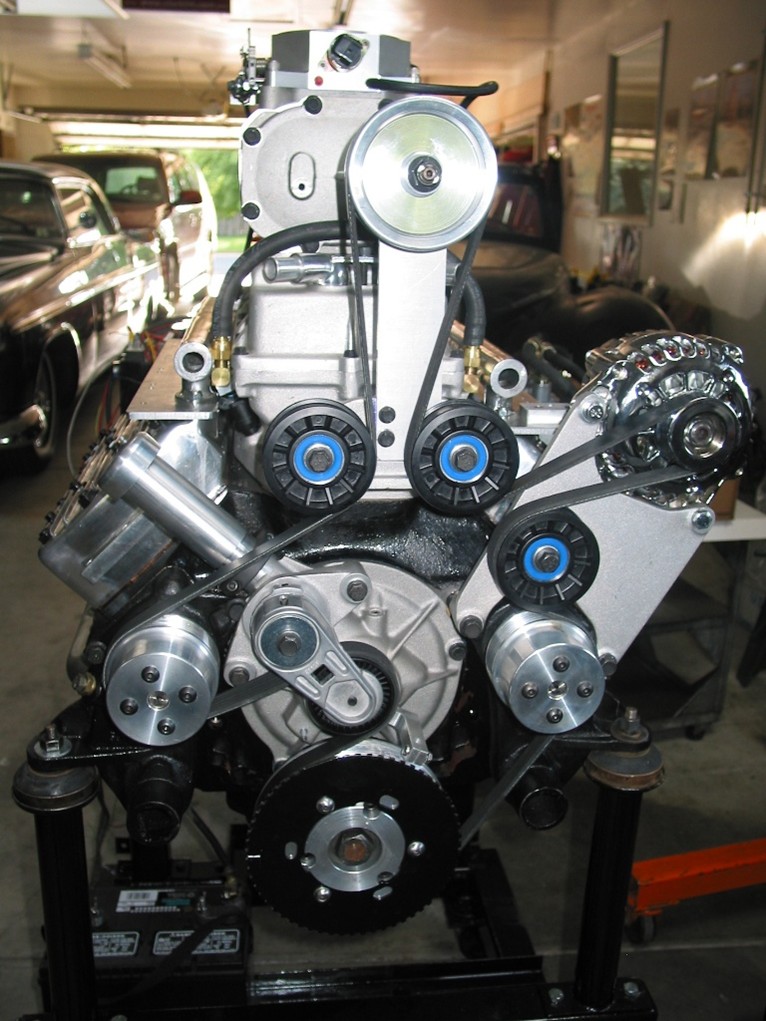
My swan song was to work with Tony Barron to build the world’s first and only (as far as I know) fuel injected, blown, crank-triggered, coil-on plug flathead engine. I called it my “old life crisis.” That engine now resides with Russ Newnes, who can have his own private crisis when he gets aroundtuit. I decided not to take any more orders as the market caught on with MSD, Holly, and others who developed self-tuning software that was essential for acceptance of this technology by the market.
So, the business failed as I thought it might. But I certainly do not regret doing it. I learned a lot, had some fun, met some great people, and it kept me active and out of the lounge chair.
Now I just focus on fiction book publishing about the 1940 Ford and have contracted with Mark Kudlow, a successful experienced movie script writer in both Europe and the USA, for two very special movie scripts. He has finished one script, “Full Throttle” and is working on the next script. Our goal is to have a technically accurate (my contribution) adventure movie at a professional level that appeals to a wide audience (his professional contribution). As an amateur regarding scripts, I had little idea about how precise and how much effort must go into writing a movie script. Mark is very patient with me and is giving me a graduate course in how to create a high caliber movie. I see a thought process very much like that required for electronic circuit design. Every word and phrase must be precise and thought out repeatedly. Here I go again on a new venture, but this one is BORN TO BE SUCCESSFUL.