
I read several articles about how this country and our society used to function in the “old days.” The old days for me were the 1950s when I was in high school, which was about 75 years ago. If I was curious about the “old days” when I was in high school, that would have been about 1875, which is 75 years back from 1950.
If my neighborhood kid, who is in high school, goes back 75 years it would be about 1950 for him. Let me take my situation that existed in 1950 and see what it would have been like in 1875. I’ll then take my neighborhood high school kid’s current situation and see what his life would have been like in 1950. I think this might lead to better understanding of how the current older generation can appreciate the current younger generation. (Don’t be concerned if you are confused now as it only gets worse from here).
In 1950 I lived in Oneonta, New York, a small city in upstate New York with a population of 25,000. For most people, when you say “New York,” they immediately think about a huge metropolis. But Oneonta, an Indian name, is in the heart of dairy country with an extensive background as a railroad town, as well as a commercial center for the surrounding farms. My paternal family goes all the way back to the American revolutionary war, so upstate New York is very much part of my heritage, even though I have now lived in Colorado for 50 years.
Let’s look back at Oneonta in 1875 and speculate how I would have lived back then and then speculate how my neighborhood kid would have lived in Oneonta in 1950.
CHARLIE’S LIFE IN 1875 ONEONTA, NEW YORK
 The family moved to the Town of Oneonta in 1854. I was born on my grandpa’s dairy farm, but my dad got a job as a fireman for the D and H Railroad, which is growing rapidly to supply coal from the Pennsylvania coal mines to the New England factories. We live in a small wooden framed house not too far from downtown, which has the only paved street.
I now go to the Academy school, which has several teachers rather than only one teacher in the one room school I went to when we lived on the farm. I am able to help some of the younger kids with reading the McGuffin Reader that is the standard method all the kids use to learn how to read. Oneonta is growing fast as the D and H Railroad is the coal supplier for the big factories in the East. It now has a hotel with a dining room, which we go to as a big treat on family birthdays.
After school I have to hurry home and do my chores. I have to split wood for the kitchen stove, make sure that the kerosene lamps are full, and dump lime once a week down the outhouse holes. On wash days I have to take down the laundry from the outdoors clothesline. My lazy older brother is not much help as he spends all his time reading the dime novels. If I have any spare time, I play horse shoes with the neighbor or even go to the meadow and play baseball. We laid out some stones for bases and one of the dads, who has a wood lathe, made a bat. A couple of the rich kids have special gloves that make catching a ball easier. There is some talk of making a regular diamond this summer.
Sundays I go to the United Methodist Church. Before church there is Sunday school for the kids. Wednesday night is prayer service, but I usually get lucky and can skip that by saying I have to do homework. A couple of times during the year, we have covered dish suppers at the church. In the spring the Academy sponsors square dancing that is a lot of fun. The girls wear all kinds of neat dresses that the moms make from the fancy feed bags. I just wear my Sunday pants and store bought shirt.
When school lets out in the summer, I will spend my time on grandpa’s dairy farm milking and feeding the cows and helping him with the horse team to plow the fields. There is one horse that grandpa lets me saddle and ride. I am usually pretty sore after that as I am not used to riding. I am worried about my dad as he seems to not have much energy anymore. He no longer plays baseball with us as he has a hard time breathing. As a fireman on the train, he breathes a lot of coal smoke, and the doctor says that hurts his lungs. We are all used to the train smoke and noise from the railroad.
I am not sure what I will do after I complete high school. My brother goes to a college in Schenectady because my mom thinks he is smart. I think he just wants to get out of having to work on the railroad. I want to become a dispatcher working out of an office to avoid getting sick or injured like so many of the dads that work on the railroad. It is so nice to live in a modern town like Oneonta. I am sure it will only get bigger and better with time.
THE NEIGHBORHOOD KID NOW AND IN 1950 ONEONTA, NEW YORK
The neighborhood kid now lives in a nice big house in Colorado and drives his Toyota SUV to high school where he takes advanced classes that will get him through college faster. He is very athletic and plays competitive volleyball and baseball. He has uniforms, equipment, coaches, and access to manicured playing fields and also goes on trips to major cities to play other teams in volleyball. He is hard working and makes money during summer vacation mowing lawns, as well as helping the family with some ambitious projects. He is constantly on his cell phone communicating with his buddies and his girlfriend (my best guess). When he mows my lawn, he has earbuds and listens to music. He is a great young man with a bright future.
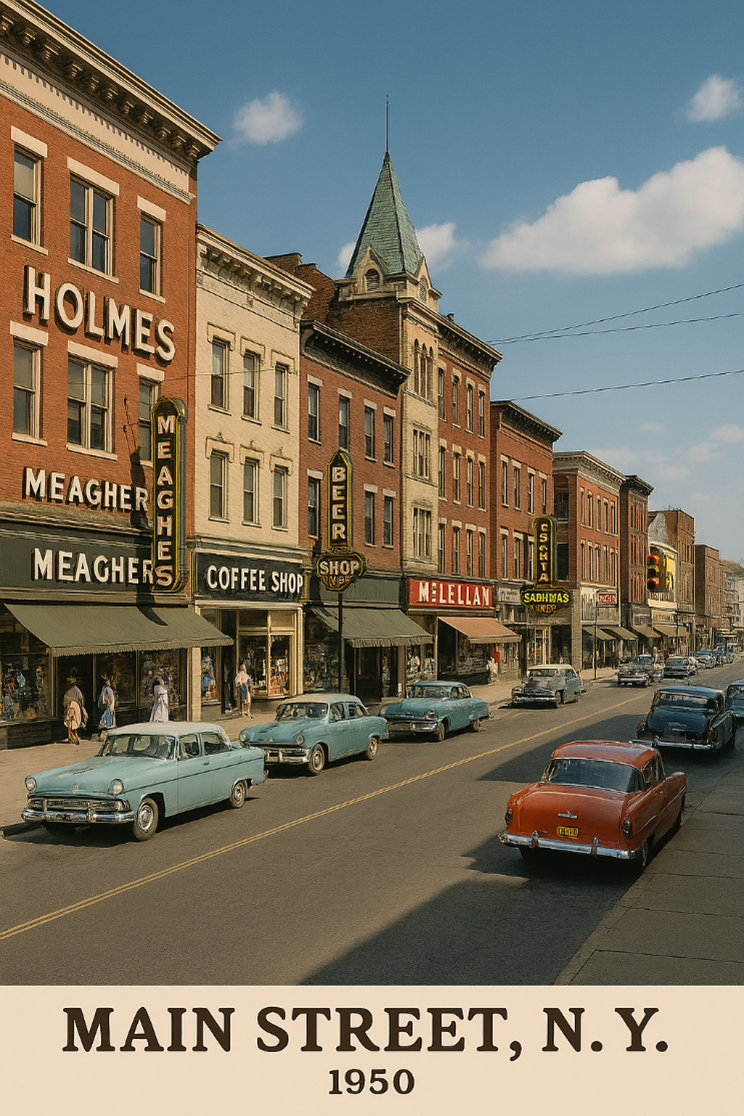 Now let’s put him in Oneonta in 1950. He would live in a house on Grand Street and ride his bike to Oneonta High School. It was rare for kids to have a car and if they did, it was probably a 1920s Model A Ford or other car from the 1920s or 1930s. He would be on the college tract and take the more advanced courses in science and mathematics taught by very dedicated, well-educated teachers.
He would probably play on the varsity basketball team and travel to Norwich or Cobleskill on the school bus for away games, while playing home games in the National Guard Armory gym since the high school gym does not have bleachers. At the end of the school year in June, he would sweat mightily in the non-air conditioned classroom where the “Regents” exams were held and taken on a voluntary basis by those students who planned on going to college. These were tests prepared by the state education department of New York and given to all eligible high school students on the exact same day and time. Acceptance into college usually requires that a student gets good scores on these tests.
If he had an after school job, it would probably be working in a gas station pumping gas, putting air in tires, and cleaning the windshield as customers were not allowed to pump their own gas for safety reasons. Oil check and windshield cleaning were expected services when gas was purchased for 25 cents a gallon. He would get paid 45 cents an hour. With this money, he could buy his high school textbooks at the local book store. He could save some money by buying used books, which the store bought back at a large discount from past students.
After supper he would have a couple of hours of homework, and he might watch a black and white TV program at the neighbor’s house as they have a TV set that they share for some special programs. He would have to compete with the rest of the family for use of the only bathroom in the house, and he probably got upset with his sister who hogged the rotary dial telephone in the downstairs hallway. His dad worked long hours for the D & H Railroad, and his mom had a job in the ladies department at Bresees Department Store. There was no such thing as a shopping mall. On weekends he would sometimes meet his mom for lunch at the popular “Health Bar.”
If the kid had a date on Saturday, he might take her to the Oneonta Theater where he could get a ticket for 50 cents. Afterwards he could treat her to a 95 cent banana split at “Karmelcorn.” Sunday was church day. His sister sang in the choir, and he was a member the Methodist Youth Fellowship (MYF), which met on Wednesdays at 7 PM in the church basement. He was also a member of Troop 30 of the Boy Scouts and, as a patrol leader, he helped younger members with their merit badge requirements. During the upcoming summer, he would be able to complete all the required merit badges at scout camp to make Eagle Scout. Not too many boys made it that far as it involved a lot of effort and dedication.
The time has come for the kid to think seriously about college. He could go to Hartwick College, a small local college, or to the Teachers College since Oneonta was well known for being a premier teachers college in the state. However, the kid wants to be an engineer, so a local college is out of the question. He is thinking about either Union College in Schenectady or Cornell University in Ithaca. Tuition is about $500 a semester, and there are book costs and fees on top of that. If he gets a summer job in construction, in addition to being given some family savings, he should be able to afford it, especially if he gets a scholarship.
He is a good responsible kid, but he almost got in trouble when he and his buddy spiked the fruit punch at the dance with a pint of vodka. None of the kids drank alcohol, and recreational drugs did not exist. Coca-Cola in a glass bottle was the recreational drink with bets made on whose bottle came from the furthest away bottling plant. He got 5 cents for each returned bottle.
Such was life in Oneonta in 1950.
2100 THE KID IS NOW AN OLD MAN
Let’s take another short flight of fancy. The kid is now an old man and great grandfather. He is telling his grandkids about what life was like back in 2025 in Centennial, Colorado. How all the kids had these funny cell phones they carried around and played with all the time. How he had a cool truck that actually ran on gasoline rather than hydrogen. Since there were no high speed 500mph trains, people used to have to fly in airplanes. Everyone had something called TV, which was used for news and entertainment. He took his great grandkids to a museum to show them an antique TV set in operation. AI was just in its infancy at that time, and on the old fashioned computers, you actually had to use a primitive keyboard to get anything done.
If you got sick, you had to go to a doctor to find out what was wrong since the robotic home health center did not exist yet. Life was a lot different back then with none of the advantages that exist now. They actually used people to build things and provide services rather than robots. People worked in something called offices, which by now have all disappeared. Hard to believe what life was like back then, isn’t it?
TIME MARCHES ON